
Horse welfare is difficult to talk about, almost impossible sometimes! It is probably because many people care so much about horses, the factors that affect their welfare are many, and the way they interact is complex and dynamic. Further, this is not helped by the fact that the concept of animal welfare has evolved over time. The way we think and talk about welfare, and what we know today, has changed more in the last 50 years than it did in the previous 500 years. The result is great confusion over what is and what isn’t animal welfare.
Welfare is a subjective experience
Instead of arguing about the definition, it may be easier to start a welfare conversation by agreeing that whatever it is, welfare is a state that someone is in at a given point in time; in our case, it is the state of the horse’s body and mind. This requires acknowledging that horses are sentient beings; so they have feelings and experiences that the horse perceives as positive (i.e., rewarding or pleasant) and negative (i.e., aversive or unpleasant).
It’s all about experiences
Experiences have important adaptive purposes; they trigger responses (physical and behavioural) aimed at helping the horse to maintain good function, or to restore balanced function in every cell, tissue, and organ, and thus overall in the body. Today, thanks to advances in the field of neuroscience, we can link observations and measures of biological function and behaviour to make confident assessments of the animal’s experiences, and whether these experiences are aversive or rewarding.
The Five Domains Model
The Five Domains Model first appeared in 1994 and has undergone many revisions and updates as the scientific knowledge associated with it has improved. The most up-to-date version is the 2020 Revision, published in Animals, authored by Prof Mellor and co-authored by Dr Ngaio Beausoleil, Dr Katherine Littlewood, Dr Andrew McLean, Prof Paul McGreevy, Dr Bidda Jones and myself.
There is increasing interest in the Five Domains Model, and it is being adopted worldwide by many equine organisations, including the International Federation for Horseracing Authorities (IFHA) and the Fédération Équestre Internationale (FEI; also known as The International Federation of Equestrian Sports). It is helping to change the way people think about animal welfare, and, best of all, it can be put into practice in the real world.
The Five Domains Model simply breaks down the horse’s experiences into more manageable chunks – the domains – so that we can make a structured and comprehensive welfare assessment. This model is ideal for anyone who wants to work out what is going well, where there are compromises or risks, and how to identify opportunities to make incremental improvements that are meaningful to the horse’s welfare.
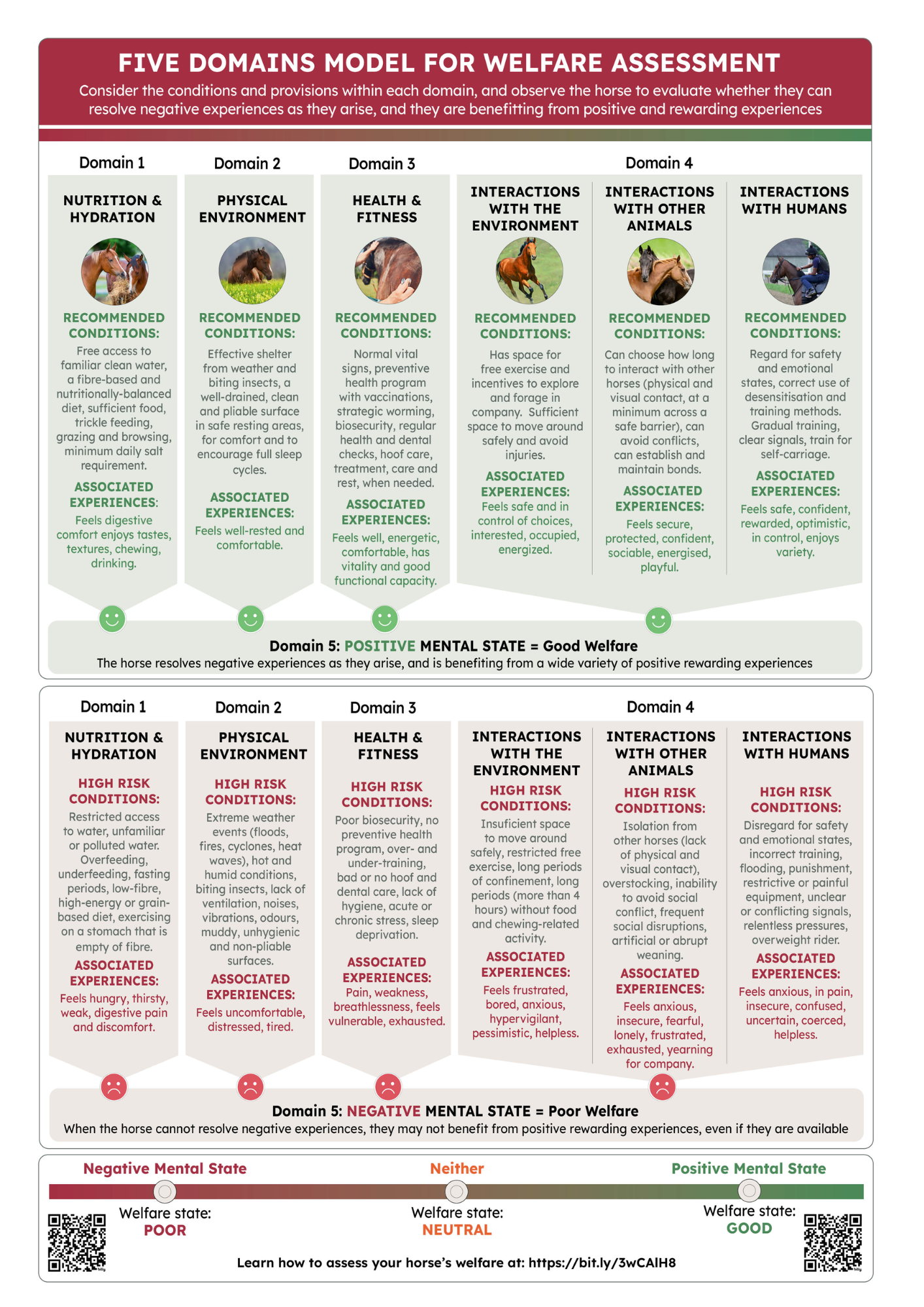
The Five Domains Model is a framework or a blueprint that helps us to systematically work through the many different aspects involved in horse management so that nothing important is missed. It involves sorting out all positive and negative experiences felt by the horse into the following four domains, so we can estimate their mental state.
Domain 1- Nutrition and hydration: This includes all the positive and negative experiences associated with the food they eat, the water they drink, and how both are presented to the horse.
Domain 2 – Physical environment: Because this domain is associated with homeostasis, it considers feelings of comfort and discomfort (physical and mental) that arise from the physical environment the horse is kept in (e.g., light conditions, temperature, air quality, noises).
Domain 3 – Health and fitness: Here take into account experiences such as the horse feeling well or sick, energetic and comfortable based on good body function, or feeling pain, discomfort and weakness from disease, injuries or other conditions.
Domain 4 – Behavioural interactions: Here we consider experiences associated with the horse’s interactions with the spaces available to them and the relationships they have with other animals and humans.
Domain 5 – Mental state: This is a crucial domain. Negative experiences tend to give rise to negative mental states, whereas resolving negative experiences and having positive experiences give rise to positive mental states.
To learn a bit more about the domains, I recommend downloading the easy-to-read resource that World Horse Welfare has produced to align with the 2020 Five Domains Model.
Figure 1. An overview of the 2020 Five Domains Model

Assessing horse welfare
The aim of welfare assessment is to identify, as accurately as possible, the experiences the horse is having at a given point in time. We do this by looking at the horse, as well as the context they are in and what’s available to them.
Think for example, about a time when you have seen your horse rolling on the ground.
What clues helped you decide whether they were in pain because of colic, or they were enjoying themselves? Think about the signs or clues that would help you decide and divide them into two groups – the ones you pick up from looking at the horse directly, based on what they are doing and how they look, and the ones that relate to the context and conditions they are in at the time. For colic being the reason for the horse rolling, there will be additional behavioural signs that you can take into account, for example, perhaps the horse was looking back at his belly before rolling, or perhaps he’s off his feed, and so on. In animal welfare science, we call these clues ‘animal-based welfare indicators’.
You might need to add the context or situation the horse is and has been in before rolling. For example, if you just untacked your horse after a ride, and turned him out, it is likely that the rolling is giving him pleasure, whereas if the horse had been in transport for a few hours or had just finished a meal, you may be concerned that the rolling is associated with colic. In animal welfare science, we call these ‘situation-related welfare indicators’.
Once you can identify how the horse is feeling, you can determine the horse’s welfare state by applying this rule of thumb: When the horse cannot resolve all the negative experiences and they have no, or very few, positive experiences, they will tend to be in a negative mental state, which is understood to be a poor or compromised welfare state. When the horse can resolve negative experiences as they arise, and they are engaging with and benefitting from a very wide range of positive experiences, they will tend to be in a positive mental state, and therefore, in a good or enhanced welfare state.
Figure 2. Experiences and how they relate to the welfare state

What other tools do we have?
Horsemanship! The accuracy of any horse welfare assessment relies on your knowledge, experience and observational skills, as well as a good understanding of what horses are as a species, how their bodies and minds function, and what is considered normal under optimal conditions. We often hear horse people say that one can never stop learning, and this should include updating ourselves on equine-related scientific research as well. This is why horsemanship has two dimensions – skill gained through experience and knowledge backed by science.
You don’t have to be an active researcher, but you do need to stay up-to-date with the latest understanding of why and how some things work and some don’t, and which horse husbandry practices and conditions tend to lead to good horse welfare outcomes, and which ones pose a risk to horse welfare. Integrating the Five Domains Model into everything you do with horses is as easy as placing each item into its relevant domain!
Figure 3. Recommended conditions for horses organised based on the 2020 Five Domains Model. These usually appear in the scientific literature as recommendations or literature reviews, and in lay textbooks as recommended guidelines.
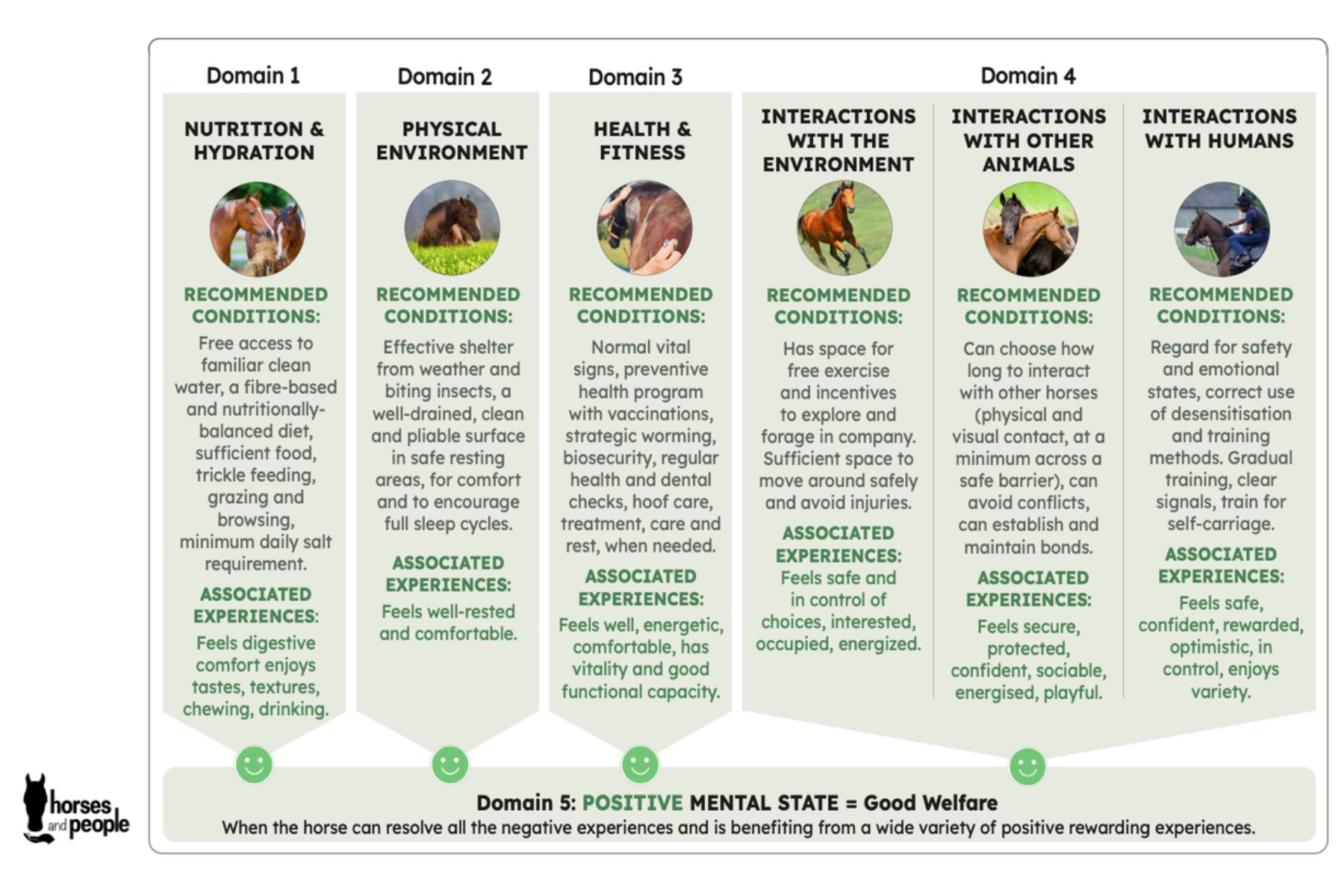
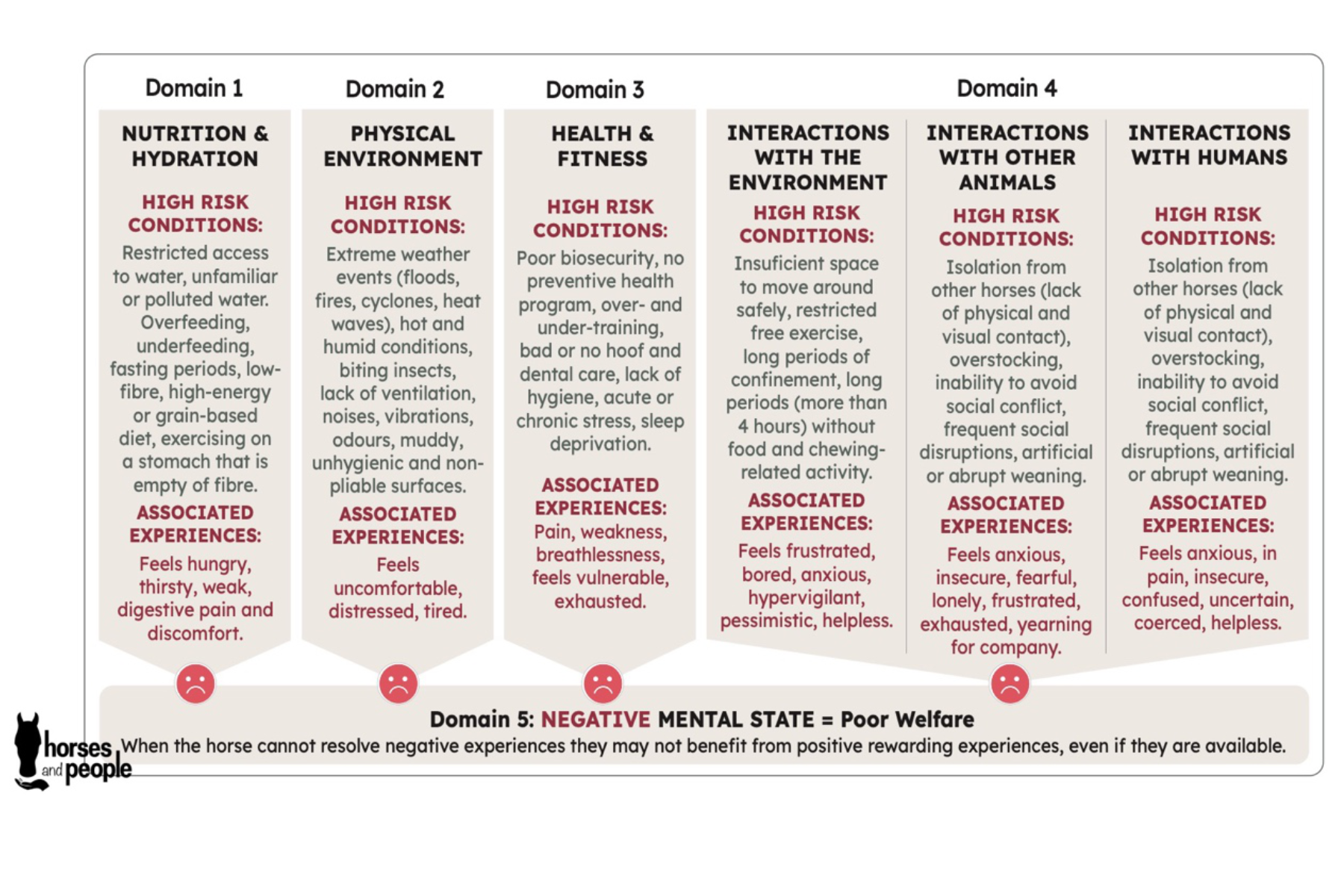
Figure 4. Conditions that are a known welfare risk for horses organised on the basis of the 2020 Five Domains Model.
Learn to apply the Five Domains Model in practice
The final step is learning how to conduct a Five Domains assessment of horse welfare in the real world. This can now be learned in your own time and online through the course “Applying the Five Domains Model to the Welfare Assessment of Sport and Recreation Horses”, hosted by the University of New England in Australia.
In this online, self-paced course, you will learn how to put this Model into practice, to identify what is going well for your horse within each of the domains, and where there are welfare risks and opportunities for making meaningful improvements to their lived experiences.
British Horse Society accredited professionals can earn 6 continued professional development (CPD) points when they complete the course. Australian veterinarians and members of the Royal College of Veterinary Surgeons can achieve 25 CPD points by doing this course. Sign up now at: https://www.openlearning.com/une/courses/une-equine-course
Reference:
Mellor, D.J.; Beausoleil, N.J.; Littlewood, K.E.; McLean, A.N.; McGreevy, P.D.; Jones, B.; Wilkins, C. The 2020 Five Domains Model: Including Human–Animal Interactions in Assessments of Animal Welfare. Animals 2020, 10, 1870. https://doi.org/10.3390/ani10101870